> For the complete documentation index, see [llms.txt](https://rudolfevergarden.gitbook.io/writeups/llms.txt). Markdown versions of documentation pages are available by appending `.md` to page URLs; this page is available as [Markdown](https://rudolfevergarden.gitbook.io/writeups/blue-tryhackme-room/tryhackme-writeups/blue-room-tryhackme.md).
# Blue Room TryHackMe
Deploy & hack into a Windows machine, leveraging common misconfigurations issues.
## Introduction
In this room we are going to learn about eternal blue exploit.
EternalBlue is a computer exploit developed by the U.S. National Security Agency (NSA). It was leaked by the Shadow Brokers hacker group on April 14, 2017, one month after Microsoft released patches for the vulnerability.
On May 12, 2017, the worldwide WannaCry ransomware used this exploit to attack unpatched computers. On June 27, 2017, the exploit was again used to help carry out the 2017 NotPetya cyberattack on more unpatched computers.
EternalBlue exploits a vulnerability in Microsoft's implementation of the Server Message Block (SMB) protocol. This vulnerability is denoted by entry CVE-2017-0144 in the Common Vulnerabilities and Exposures (CVE) catalog. The vulnerability exists because the SMB version 1 (SMBv1) server in various versions of Microsoft Windows mishandles specially crafted packets from remote attackers, allowing them to remotely execute code on the target computer.\
\
Source: Wikipedia
## Blue Room TryHackMe
### Room Initial View
Initial room view
Room Tasks
The questions given in the room to be solved
The Room has 5 tasks to be solved.\
**Task 1: Recon**\
**Task 2: Gain Access**\
**Task 3: Escalate**\
**Task 4: Cracking**\
**Task 5: Find Flags!**
Lets start the machine and complete the tasks.
## **Task 1: Recon**
lets take a look at the questions from task 1
These are the questions given in Task 1
now to get the answers for this questions we need to scan the target machine ip with Nmap.
### Scanning the target
I opened the attack box and started the Nmap scan.
```sh
root@attack-box:~# nmap -A -sV -script vuln [target-ip]
```
Scan result from Nmap
{% code overflow="wrap" %}
```shell
root@attack-box:~# nmap -A -sV -script vuln [target-ip]
Starting Nmap 7.60 ( https://nmap.org ) at yyyy-mm-dd hh:mm GMT
Nmap scan report for attack-box
Host is up (0.00044s latency).
Not shown: 991 closed ports
PORT STATE SERVICE VERSION
135/tcp open msrpc Microsoft Windows RPC
139/tcp open netbios-ssn Microsoft Windows netbios-ssn
445/tcp open microsoft-ds Microsoft Windows 7 - 10 microsoft-ds (workgroup: WORKGROUP)
3389/tcp open ms-wbt-server Microsoft Terminal Service
| rdp-vuln-ms12-020:
| VULNERABLE:
| MS12-020 Remote Desktop Protocol Denial Of Service Vulnerability
| State: VULNERABLE
| IDs: CVE:CVE-2012-0152
| Risk factor: Medium CVSSv2: 4.3 (MEDIUM) (AV:N/AC:M/Au:N/C:N/I:N/A:P)
| Remote Desktop Protocol vulnerability that could allow remote attackers to cause a denial of service.
|
| Disclosure date: 2012-03-13
| References:
| http://technet.microsoft.com/en-us/security/bulletin/ms12-020
| https://cve.mitre.org/cgi-bin/cvename.cgi?name=CVE-2012-0152
|
| MS12-020 Remote Desktop Protocol Remote Code Execution Vulnerability
| State: VULNERABLE
| IDs: CVE:CVE-2012-0002
| Risk factor: High CVSSv2: 9.3 (HIGH) (AV:N/AC:M/Au:N/C:C/I:C/A:C)
| Remote Desktop Protocol vulnerability that could allow remote attackers to execute arbitrary code on the targeted system.
|
| Disclosure date: 2012-03-13
| References:
| http://technet.microsoft.com/en-us/security/bulletin/ms12-020
|_ https://cve.mitre.org/cgi-bin/cvename.cgi?name=CVE-2012-0002
|_sslv2-drown:
49152/tcp open msrpc Microsoft Windows RPC
49153/tcp open msrpc Microsoft Windows RPC
49154/tcp open msrpc Microsoft Windows RPC
49158/tcp open msrpc Microsoft Windows RPC
49160/tcp open msrpc Microsoft Windows RPC
MAC Address: 02:B4:F6:22:77:31 (Unknown)
No exact OS matches for host (If you know what OS is running on it, see https://nmap.org/submit/ ).
Network Distance: 1 hop
Service Info: Host: JON-PC; OS: Windows; CPE: cpe:/o:microsoft:windows
Host script results:
|_samba-vuln-cve-2012-1182: NT_STATUS_ACCESS_DENIED
|_smb-vuln-ms10-054: false
|_smb-vuln-ms10-061: NT_STATUS_ACCESS_DENIED
| smb-vuln-ms17-010:
| VULNERABLE:
| Remote Code Execution vulnerability in Microsoft SMBv1 servers (ms17-010)
| State: VULNERABLE
| IDs: CVE:CVE-2017-0143
| Risk factor: HIGH
| A critical remote code execution vulnerability exists in Microsoft SMBv1
| servers (ms17-010).
|
| Disclosure date: 2017-03-14
| References:
| https://cve.mitre.org/cgi-bin/cvename.cgi?name=CVE-2017-0143
| https://technet.microsoft.com/en-us/library/security/ms17-010.aspx
|_ https://blogs.technet.microsoft.com/msrc/2017/05/12/customer-guidance-for-wannacrypt-attacks/
TRACEROUTE
HOP RTT ADDRESS
1 0.44 ms attack-box
OS and Service detection performed. Please report any incorrect results at https://nmap.org/submit/ .
Nmap done: 1 IP address (1 host up) scanned in 169.88 seconds
```
{% endcode %}
now with this scan we found the how many ports are open and also the vulnerability's in the machine given.
Now with the information gathered we can answer all the questions in Task 1
## **Task 2: Gain Access**
Question's in Task 2
In Task 2 to get the answers we need to use [Metasploit](https://tryhackme.com/room/rpmetasploit).
Lets start metasploits
after the Metasploit has open'd search for 'ms17-010' since we found that the vulnerability from Nmap scan.
Lets check the options and use the exploit
Set RHOST to the target machine ip
Now we exploit and wait for the exploit to finish.
Exploit completed and succesful.
Some times the exploit might fail but just run it again or restart the machine.
my exploit was success and even the meterpreter session was created.
now type shell to open cmd of the victim.
shell successful
*if you are running from kali VM make sure to set LHOST as tun0.*
now with the information gathered we can answer all the questions present in task 2
## **Task 3: Escalate**
Let's take a look at the questions from task 3
## Task 4: **Cracking**
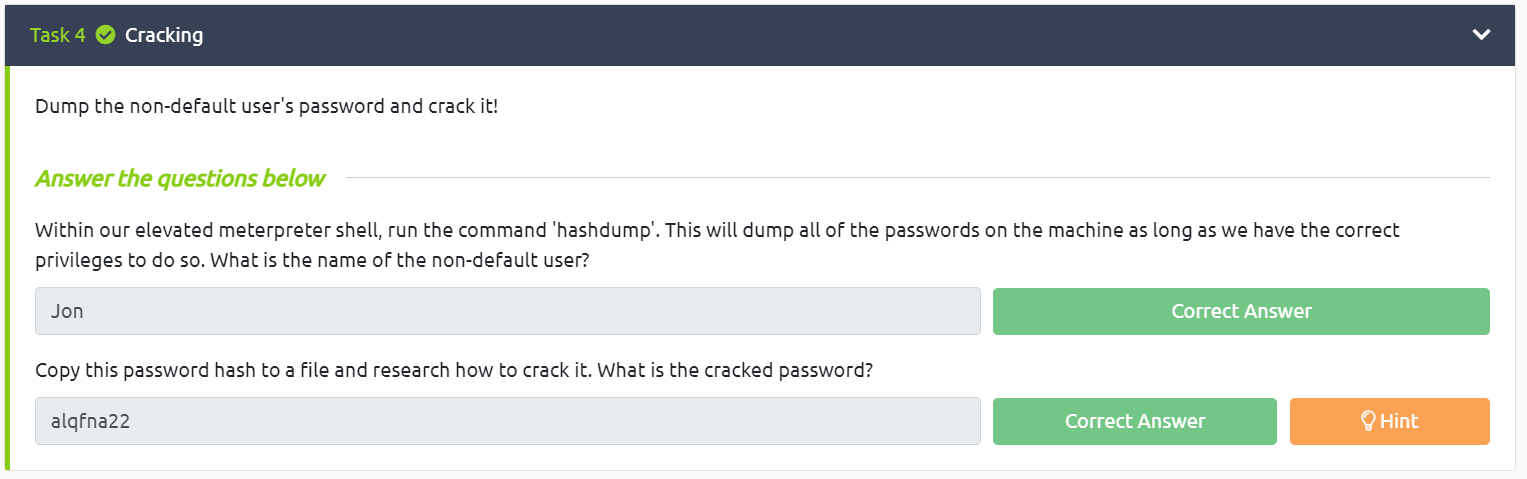
lets taka look at the questions from task 4
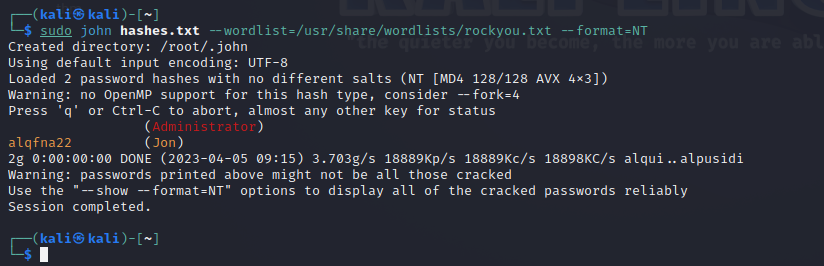
to crack the hashes we use john with rockyou.txt as the wordlist
if this is your first time using the rockyou.txt wordlist you need to first unzip it and then use it
unziping rockyou.txt.gz
make sure that only the username and the hash are present in the hash file
now run john against the hash's we get the password in plain text.
cracking hash with john
{% embed url="" %}
you can also check this page to crack the NTLM passwords.
{% endembed %}
now with the information gathered we can answer all the questions present in task 4.
## Task 5: **Find Flags!**
now to find the flags we go to the starting of the directory and search for the file name with flag
```
dir *flag*.txt /s
```
now we found the locations of the flags.
submit the flags and enjoy your new blue batch when completed.
Until next time...